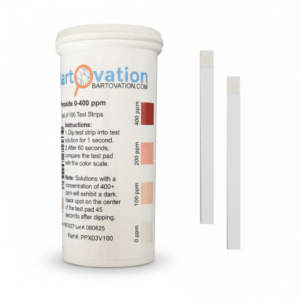
This test strip measures levels of free available chlorine (FAC) in a solution. The bottle has easy to read color blocks at 0, 50, 100, 250, 500, and 1,000 ppm. This test strip is very easy to use, and gives results in just seconds. This test strip is used where higher levels of disinfection are required. The higher range provides a much higher degree of certainty that all organisms are either killed or rendered ineffective. It is ideal for daycares, senior homes, and cruise lines sanitation requirements.
How to test for chlorine:
Remove one Free Chlorine test strip from the vial, being careful not to touch the test pad with your fingers.
Dip the test strip into the solution being tested for 1-2 seconds.
Remove and immediately compare against the color chart.
Additional information
Weight
1.5 oz
Dimensions
4 × 2.75 × 2.75 in
reviewtag
elfsight-app-a078f49d-1ba3-4410-8e3a-038c563875c2
Intended Use
Daycares, cruises, senior homes
Color Chart Increments
0, 50, 100, 250, 500, 1, 000 ppm
Result Format
Visual semi-quantitative color comparison against printed reference chart on vial
Test Time
60 seconds
Storage Requirement
Store in a cool, dry place, out of direct sunlight
Strip Dimensions
2.5" (L) x .1875" (W) [64mm (L) x 5mm (W)]
Number of Strips
100
NO
calibration, laboratory, electronic meter, or drop counting required!
Frequently Asked Questions (FAQ)
Q: Why did my chlorine test strips turn blue instead of showing the expected range of purples on the color chart?
A: The blue color you’re seeing on the test strips likely indicates the presence of other oxidizing agents in your solution—most commonly hydrogen peroxide or peracetic acid. These substances can interfere with chlorine test strips by reacting with the test pad, causing a false reading. When strong oxidizers are present in higher concentrations, they can overwhelm the test strip’s chemistry and turn it blue, which is not part of the normal chlorine range indicated by the purple color scale.
To confirm whether your test strips are functioning correctly, we recommend a simple control test: mix 1 tablespoon of regular household bleach (sodium hypochlorite) into 1 gallon of deionized water. This should produce a free chlorine concentration between 200–400 ppm, depending on the bleach’s original strength. If your test strips show the correct purple color in this solution, they are working properly, and the issue is with your test sample—most likely due to interference from other oxidizers.