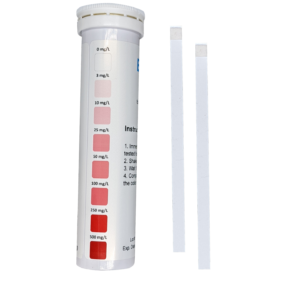
The Iron test strip measures Fe2+ (ferrous) or Fe3+ (ferric) in water from 0-100ppm in just seconds. This test strip has steps of 0, 2, 10, 25, 50, and 100ppm on the color chart. The Iron test strips only work on iron ions that are free in solution. They will not detect Iron that is complexed with a chelating agent, such as EDTA. Iron chelates are often used in products such as fertilizer to aid in improving the availability of the iron as a plant nutrient. Instructions: Remove one Iron test strip from the vial. Immerse the test strip into the solution being tested for 2-3 seconds. Remove and compare to the color chart after 30 seconds.
When testing a sample I get a yellow reading. I believe there is iron in the sample but it is not showing any blue. Why is this?
One potential reason is your sample may have below 1 ppm dissolved iron which is the limit of detection of this strip. If that is the case we would recommend this low range iron test strip. Our test can detect only soluble iron. The yellow coloration observed in the sample is consistent with the presence of iron oxides. Some lab tests based on EPA Method 200.7 use ICP-OES (Inductively Coupled Plasma–Optical Emission Spectrometry). This method measures both soluble iron (Fe²⁺ and Fe³⁺) and insoluble forms (e.g., rust and iron oxides) by first performing acid digestion. In this process, nitric acid is used and the sample is heated for an extended period to convert all iron into a dissolved, detectable form. Since rust and iron oxides are not detectible by our test you are getting this unexpected result.

![Iron Test Strips, <span class="bldppm">0-100 ppm</span> [Vial of 50 Strips] for Measuring Free Soluble Iron (Fe2+ and Fe3+)](https://bartovation.com/wp-content/uploads/2020/03/PWQ05V50-main-scaled.webp)
![Iron Test Strips, <span class="bldppm">0-100 ppm</span> [Vial of 50 Strips] for Measuring Free Soluble Iron (Fe2+ and Fe3+) - Image 2](https://bartovation.com/wp-content/uploads/2020/03/PXL_20230601_203348430-1.png)
![Phosphorus and Phosphate Detection Test Strips, 0-100 ppm [Vial of 50 Strips]](https://bartovation.com/wp-content/uploads/2020/03/61AwwO6HdSL._SL1500_-300x300.jpg)
![Total Iron Test Strips for Measuring Water, 0-10 ppm [Vial of 25 Strips]](https://bartovation.com/wp-content/uploads/2025/03/DWQ12V25-main-300x300.jpg)
![Magnesium Test Strips, 0-1000 ppm [Vial of 25 Strips]](https://bartovation.com/wp-content/uploads/2024/07/DWQ15V25-main-300x300.jpg)