
The Science of Dairy Hydrolysis & Lactase Activity
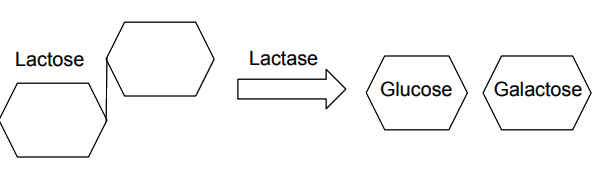
Background for Educators and Students Lactose is a large disaccharide (double sugar) naturally found in the milk of mammals. Chemically, it consists of two simple sugar molecules—glucose and galactose—bonded together. To digest this sugar, the human body produces an enzyme called lactase (or β-galactosidase) in the small intestine, which performs a process called hydrolysis to break that chemical bond.
The Biological Mystery: While most infants produce abundant lactase, approximately 68% of the global population experiences “lactase nonpersistence,” where the gene for lactase production essentially turns off after weaning (1). Without enough lactase, undigested lactose moves into the colon. There, it affects the osmotic balance, drawing water into the intestine and being fermented by bacteria, which leads to the characteristic symptoms of bloating, gas, and diarrhea. Interestingly, lactose tolerance is often a result of “lactase persistence,” a genetic mutation historically linked to populations with a long history of dairy farming, such as those of Northern European descent.
Lab: The “Mystery Drop” Challenge
Goal: Use glucose-specific chemistry to identify which milk is “lactose-free” and demonstrate how enzymes can predigest food.
I. Materials Needed
- Bartovation Scientific Glucose Test Strips (0-3000 mg/dL)
- Sample A: Regular Whole Milk
- Sample B: 100% Lactose-Free Milk (e.g., Lactaid)
- “Mystery Drops”: Liquid Lactase Enzyme (labels removed)
- Control: 2% Glucose solution (2g glucose in 100mL water)
- Clear test tubes and a timer
II. Pre-Lab: Validation & Controls
- Negative Control: Dip a strip into distilled water. It should remain blue/negative.
- Positive Control: Dip a strip into the 2% glucose solution. This ensures the strips are active and reveals what a positive result looks like.
- Always remove a strip and reseal the vial immediately to protect the remaining strips from moisture
-
![Scientific Glucose Test Strips, <span class="bldppm">0-3000 mg/dL</span> [Bag of 50 Plastic Strips] for Food Science or Osmosis/Diffusion Experiments](data:image/svg+xml,%3Csvg%20xmlns='http://www.w3.org/2000/svg'%20viewBox='0%200%20950%20950'%3E%3C/svg%3E) $24.24
$24.24
![Scientific Glucose Test Strips, <span class="bldppm">0-3000 mg/dL</span> [Bag of 50 Plastic Strips] for Food Science or Osmosis/Diffusion Experiments](https://bartovation.com/wp-content/uploads/2026/06/PSS05B50-MAIN-2500x2500.jpg)
III. Experimental Procedure
Phase 1: Detecting “Hidden” Glucose
- Pour 3 mL of Sample A and Sample B into separate labeled tubes.
- Test Sample A: Completely immerse the test pad of a fresh strip for 1-2 seconds. Run the strip along the edge of the tube to remove excess liquid.
- Wait exactly 3 minutes before comparing the pad to the color chart. Record the mg/dL of glucose.
- Test Sample B: Repeat the process with a new strip.
- Observation: One sample will test negative (0 mg/dL), while the other will show a high concentration of glucose. Why? Lactose-free milk is actually glucose-rich because the manufacturer has already used enzymes to break the lactose down for you.
Phase 2: The Enzyme Activation
- Add one “Mystery Drop” (lactase) to the tube that originally tested negative for glucose.
- Warm the tube by rolling it between your hands for 2 minutes to simulate human body temperature.
- Test the solution again with a new glucose test strip.
- Observation: The solution that was previously negative will now show a positive glucose reading, proving the “Mystery Drops” successfully performed hydrolysis.
Bartovation Expert Tips for Success
- Do Not Touch the Pad: Skin oils and contaminants can interfere with the enzymatic reaction on the strip.
- The Wait Time Matters: Bartovation’s Glucose strips are calibrated for a 3-minute read time to ensure the color intensity accurately matches the 0-3000 mg/dL scale.
- Understanding Mutarotation: In liquid samples, glucose must undergo “mutarotation” (a shift in its molecular structure) for the strip’s enzyme to detect it fully. While reactions in milk are often fast, if you are testing a prepared solution, let it sit for up to 3 hours for the most accurate quantitative results.
Continued Thought Questions
Q: Can I use these strips to test for table sugar?
A: No. These strips use an enzyme specific only to glucose. Sucrose (table sugar) is a different disaccharide that will not react with the strip, even though it contains a glucose molecule, because the bond is different and requires a different enzyme (sucrase) to break it.
Q: Why does regular milk test negative if it’s full of sugar?
A: Regular milk contains lactose, not glucose. The glucose strip only detects “simple” glucose that is free and unbound. Once the lactase enzyme breaks the lactose bond, the glucose is freed and the strip can detect it.
Refrences:
- Storhaug CL, Fosse SK, Fadnes LT. Country, regional, and global estimates for lactose malabsorption in adults: a systematic review and meta-analysis. The Lancet. Gastroenterology & Hepatology. 2017;2(10):738–746.
This lab is designed for educational use only in food science and biology classrooms.
Discover even more ways to use glucose test strips in the classroom with two additional hands-on labs. Explore Diffusion and Osmosis Using Dialysis Tubing to visualize how molecules move across a semipermeable membrane, or investigate The Sweet Side of Bananas to measure how glucose levels change as bananas ripen. Both activities reinforce core biology and chemistry concepts through simple, engaging experiments using Bartovation Glucose Test Strips.